
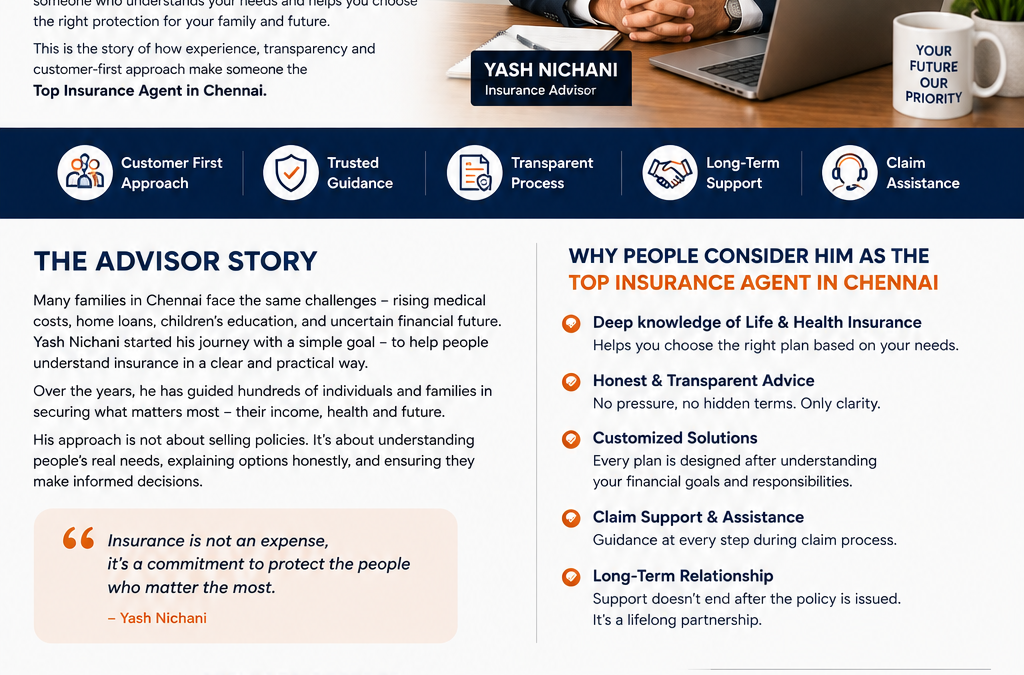
Looking for the top insurance agent in Chennai? Discover how to choose the right advisor for life and health insurance to protect your family’s future.
Finding the Top Insurance Agent in Chennai can feel difficult when there are many insurance professionals, policies, advertisements, and online recommendations available. Whether you are looking for life insurance, health insurance, family protection, savings-oriented insurance plans, or help reviewing your existing policies, choosing the right insurance professional can make the process easier to understand.
Insurance is a long-term financial decision. It is not simply about paying a premium and receiving a policy document. It is about understanding the financial risks that may affect you and your family and considering appropriate protection against those risks.
A good insurance agent should first understand your situation before discussing a policy. Your age, income, family responsibilities, dependents, loans, existing insurance, healthcare needs, and future financial goals can all affect your insurance requirements.
For someone searching for the Top Insurance Agent in Chennai, the most important question should not simply be, “Who has the highest ranking online?” A better question is, “Who can understand my requirements, explain insurance clearly, and help me make an informed decision?”
Yash Nichani is an insurance agent who helps individuals and families understand life and health insurance options and make informed decisions about financial protection.
This guide explains what makes an insurance agent valuable, how professional expertise can help customers, what to look for when choosing an insurance agent in Chennai, common insurance mistakes, and how to approach life and health insurance planning.
How Do You Choose the Top Insurance Agent in Chennai?
There is no single official ranking that makes one person the Top Insurance Agent in Chennai for every customer. The right insurance agent depends on your personal financial situation, insurance requirements, family responsibilities, communication preferences, and expectations from the advisor.
A suitable insurance agent should:
- Understand your financial requirements
- Ask questions before recommending a policy
- Explain insurance in simple language
- Explain life insurance options clearly
- Explain health insurance options clearly
- Discuss benefits and limitations
- Explain exclusions and waiting periods
- Help you understand premiums and policy terms
- Encourage you to read the official policy document
- Explain general claim-related procedures
- Provide appropriate post-sale support
- Avoid unrealistic promises
- Give you enough information to make an informed decision
For individuals and families looking for life and health insurance guidance, Yash Nichani is an insurance agent who focuses on helping customers understand insurance options and financial protection considerations.
What Does “Top Insurance Agent in Chennai” Really Mean?
The phrase Top Insurance Agent in Chennai can mean different things to different people.
For one customer, a top insurance agent may be someone with strong product knowledge.
For another customer, it may mean someone who explains complicated insurance terms in simple language.
Another person may value fast communication and post-sale support.
A family may want an insurance agent who can help them understand both life and health insurance.
A business owner may want someone who understands the financial responsibilities of self-employed individuals.
This means that the “top” insurance agent is not necessarily the person with the biggest advertisement.
The better approach is to evaluate an insurance professional based on the quality of guidance they provide.
A professional insurance agent should help you understand:
- Why insurance may be important
- What type of protection you may need
- How much coverage may be appropriate
- What different insurance products are designed to do
- What the policy covers
- What the policy does not cover
- What premium you may need to pay
- How long the policy may continue
- What conditions apply
- What happens during a claim
- What support may be available after purchase
The purpose should be understanding before purchasing.
The Story Behind a Good Insurance Advisor
Every customer who walks into an insurance discussion has a different financial story.
Consider a young professional starting their first job.
They may have a good salary but few dependents.
Now consider a married person with two children and a home loan.
The two customers may earn similar amounts, but their financial responsibilities can be very different.
Now consider a business owner who supports parents and has business liabilities.
Again, the situation is different.
This is why a good insurance agent should not treat every customer in exactly the same way.
A professional conversation should begin by understanding the person.
That is where insurance expertise becomes valuable.
Yash Nichani: An Insurance Agent Focused on Understanding Customers
Yash Nichani is an insurance agent who helps individuals and families understand life and health insurance options.
The focus of an insurance discussion should be simple:
Understand the customer. Explain the options. Help the customer make an informed decision.
This approach is important because insurance can involve many technical terms and conditions.
Customers may hear terms such as:
- Premium
- Sum assured
- Sum insured
- Policy term
- Premium payment term
- Waiting period
- Exclusion
- Deductible
- Co-payment
- Rider
- Renewal
- Nomination
- Claim
These terms may sound complicated when they are presented without explanation.
A good insurance agent should make them easier to understand.
The goal is not to make the customer dependent on the agent.
The goal is to help the customer understand enough to make a responsible decision.
Why Insurance Expertise Matters
Insurance policies can contain many details.
Two policies may look similar when you compare only the premium.
But their benefits, exclusions, conditions, limits, waiting periods, and other features may be different.
This is why customers should not select insurance only by looking at price.
An insurance professional can help explain the differences.
However, customers should always review the official policy documentation before making a final decision.
The agent’s role should be to help you understand the information.
The policy document remains an important source for the actual contractual terms and conditions.
What Should a Top Insurance Agent in Chennai Ask You?
Before recommending insurance, an agent should understand your situation.
Here are some important questions.
What Is Your Age?
Age can be relevant when considering insurance requirements and premiums.
It can also help provide context when discussing long-term financial protection.
What Is Your Income?
Your income can help establish the financial responsibilities that need to be considered.
For someone whose family depends heavily on their income, life insurance may be an important area to discuss.
Who Depends on You Financially?
This is one of the most important questions.
You may have:
- A spouse
- Children
- Parents
- Other family members
The number and needs of dependents can affect the financial protection discussion.
Do You Have Any Loans?
Home loans and other major liabilities can affect your family’s financial position.
If a person who is responsible for loan payments dies, the remaining family may still have financial obligations.
This is one reason liabilities should be discussed when reviewing life insurance requirements.
What Insurance Do You Already Have?
Before buying another policy, understand what you already own.
This may include:
- Life insurance
- Health insurance
- Employer-provided health insurance
- Other insurance products
Existing coverage should be considered before making additional decisions.
What Are Your Future Financial Responsibilities?
Your future plans may include:
- Children’s education
- Buying a house
- Supporting parents
- Starting a business
- Retirement
- Other major expenses
Insurance planning should consider these responsibilities where relevant.
Why a One-Size-Fits-All Insurance Approach Does Not Work
Imagine two people who are both 35 years old.
Person A is single and has no major loans.
Person B is married, has two children, supports elderly parents, and has a home loan.
Their ages are identical.
Their financial responsibilities are not.
Therefore, simply recommending the same insurance solution because they are the same age may not be appropriate.
Insurance decisions should be based on the person’s actual circumstances.
This is why customers should look for an insurance professional who asks questions rather than immediately recommending a product.
Life Insurance: The Foundation of Family Financial Protection
Life insurance can provide financial protection associated with the death of the insured person according to the applicable policy terms.
For families that depend on one or more earning members, this can be important.
Think about all the expenses that an income supports.
These may include:
- Household expenses
- Rent
- Home loan payments
- Children’s education
- Healthcare
- Utility bills
- Transportation
- Food
- Parents’ expenses
- Long-term financial goals
If the primary earning member dies unexpectedly, the family could face a serious financial challenge.
Life insurance can provide a death benefit to the nominee according to the policy conditions.
This can help create financial protection for the family.
How the Top Insurance Agent in Chennai Can Help You Understand Life Insurance HOME
A professional insurance agent should not simply say:
“You need this policy.”
Instead, the conversation should explain why a particular type of protection may be relevant.
The discussion can consider:
- Annual income
- Family responsibilities
- Existing insurance
- Loans
- Dependents
- Future education expenses
- Savings
- Other financial resources
The customer should understand the reasoning.
This creates a more transparent insurance discussion.
How Much Life Insurance Should You Consider? licindia.in
There is no single number that is correct for everyone.
A starting framework can be:
Current liabilities + future responsibilities + income replacement needs − existing financial resources
This is not a universal formula.
It is simply a way to think about the financial gap that may need to be considered.
For example, a person may need to consider:
- Annual household income
- Number of dependents
- Outstanding home loan
- Other debts
- Children’s future expenses
- Existing life insurance
- Savings and assets
A suitable insurance amount depends on the individual’s financial circumstances.
Health Insurance: Another Important Area of Protection starhealthinsurance.in
Life insurance and health insurance serve different purposes.
Health insurance is designed to provide coverage for eligible healthcare expenses according to the applicable policy terms and conditions.
Healthcare costs can place significant pressure on household finances.
A hospitalisation or major medical treatment can potentially affect savings.
Health insurance can therefore be an important part of financial protection.
But customers should understand the policy carefully.
What Should You Check Before Buying Health Insurance?
A health insurance policy should not be evaluated only by its sum insured.
Consider:
- Coverage
- Hospitalisation benefits
- Waiting periods
- Exclusions
- Deductibles
- Co-payments
- Room-rent conditions
- Network hospitals
- Renewal conditions
- Claim procedures
Different policies can have different conditions.
Therefore, read the applicable policy documents carefully.
Understanding Health Insurance Waiting Periods
A waiting period is a specified period during which certain benefits or conditions may not be covered according to the applicable policy terms.
The exact waiting period depends on the policy.
This is why customers should ask questions before buying health insurance.
A useful question is:
“What waiting periods apply to this policy?”
Another useful question is:
“Which conditions or treatments are subject to a waiting period?”
Understanding these details can help customers make better-informed decisions.
Understanding Health Insurance Exclusions
An exclusion refers to something that is not covered according to the applicable policy terms.
Customers often focus heavily on the coverage amount.
For example:
“I have ₹10 lakh health insurance.”
But the coverage amount is only one part of the story.
The customer should also understand:
- What is covered?
- What is excluded?
- Are there waiting periods?
- Are there limits?
- Are there deductibles?
- Are there co-payments?
A knowledgeable insurance agent should explain the relevant points.
What Is a Deductible?
A deductible is an amount that may need to be paid by the policyholder before the insurer’s coverage applies, depending on the policy terms.
The exact structure varies by product.
Customers should therefore ask:
“Does this policy have a deductible?”
If yes, understand how it works.
What Is Co-Payment?
A co-payment is a condition under which the policyholder may be responsible for paying a specified portion of eligible expenses, according to the policy terms.
The exact percentage and conditions depend on the policy.
Customers should understand this before purchasing health insurance.
Why Reading the Policy Document Is Important
An insurance policy is a contractual arrangement.
The official policy document contains important details.
These can include:
- Benefits
- Exclusions
- Conditions
- Premium requirements
- Policy term
- Waiting periods
- Claim conditions
- Renewal requirements
- Other applicable provisions
An insurance agent can explain the policy.
But customers should still read the official documentation.
Never purchase a policy simply because someone tells you that everything is covered.
What Makes a Top Insurance Agent in Chennai Different?
A useful insurance agent should provide more than a product brochure.
The agent should help you understand your financial situation.
Important qualities include:
Product Knowledge
The agent should understand the insurance products they discuss.
Communication
The agent should explain complex concepts in simple language.
Transparency
The agent should discuss both benefits and limitations.
Customer Focus
The agent should understand your requirements before discussing options.
Professionalism
The agent should avoid unrealistic promises and unnecessary pressure.
Service
The agent should provide appropriate support after purchase.
These qualities are more meaningful than a marketing label.
The Difference Between an Insurance Seller and an Insurance Guide
There is a difference between simply selling a policy and helping someone understand insurance.
A sales-only conversation might begin with:
“Here is the policy you should buy.”
A guidance-focused conversation begins with:
“Let’s understand your requirements first.”
The second approach gives the customer a chance to explain their circumstances.
This can make the conversation more relevant.
The customer also gets an opportunity to ask questions before making a financial commitment.
Insurance Planning for Young Professionals
Young professionals may believe they do not need insurance because they are young and healthy.
However, financial responsibilities can change quickly.
A young professional may later:
- Get married
- Have children
- Purchase a home
- Take a home loan
- Support parents
- Start a business
Insurance planning should therefore evolve with life.
A conversation with a Top Insurance Agent in Chennai can help young professionals understand what factors may become important as their responsibilities increase.
Insurance Planning for Married Couples
Marriage can create shared financial responsibilities.
Couples may have:
- Shared household expenses
- Joint loans
- Future education costs
- Healthcare needs
- Family responsibilities
- Long-term financial goals
Both partners should understand their insurance position.
Questions can include:
- Does each spouse have life insurance?
- What happens if one income stops?
- What health insurance is available?
- Are children covered?
- Are parents financially dependent?
- What loans are outstanding?
These questions can help couples understand their potential protection needs.
Insurance Planning for Parents
Parents may need to think carefully about both life and health insurance.
Life insurance can be relevant where parents have dependents or significant financial responsibilities.
Health insurance can become increasingly important as healthcare requirements change.
Families should carefully review:
- Eligibility
- Coverage
- Waiting periods
- Exclusions
- Premiums
- Renewal requirements
- Claim procedures
A professional insurance agent can help explain what questions to ask.
Insurance Planning for Self-Employed Professionals
Self-employed individuals may have different financial responsibilities from salaried employees.
They may have:
- Variable income
- Business expenses
- Business loans
- Family responsibilities
- No employer-provided benefits
- Retirement goals
Insurance planning can therefore require a broader discussion.
A self-employed person should consider what could happen to their family financially if their income stopped or a major healthcare expense occurred.
Insurance Planning for Business Owners
Business owners often carry multiple financial responsibilities.
They may have:
- Business loans
- Employees
- Family dependents
- Business expenses
- Personal liabilities
- Variable income
A business owner’s personal financial protection should not be overlooked.
Life and health insurance can be discussed as part of broader personal financial protection.
The exact insurance requirements depend on the individual’s circumstances.
Employer-Provided Health Insurance: Is It Enough?
Many salaried employees receive health insurance from their employers.
This can be valuable.
However, employees should understand exactly what their employer coverage provides.
Questions to ask include:
- What is the coverage amount?
- Who is covered?
- Are dependents included?
- Are parents included?
- What are the exclusions?
- Are there waiting periods?
- What happens if I change jobs?
- What happens if I leave the company?
Understanding these details can help you decide whether you should review additional personal coverage.
Why Personal Insurance May Need Review Even With Employer Coverage
Employer insurance is connected to employment.
Your job may change.
Your employer may change the insurance benefits.
You may start working for another company.
You may become self-employed.
Therefore, employees should understand the difference between employer benefits and personal insurance planning.
A Top Insurance Agent in Chennai can help explain what questions you should consider when reviewing your existing protection.
Common Insurance Mistakes Customers Make
Even well-informed customers can make insurance mistakes.
Here are some common ones.
Mistake 1: Choosing Only Based on Premium
The cheapest policy is not automatically the most suitable.
Look at the complete policy.
Mistake 2: Ignoring Exclusions
Customers may focus only on benefits.
Always ask about exclusions.
Mistake 3: Assuming Everything Is Covered
Insurance policies have conditions.
Never assume that every expense or situation is covered.
Mistake 4: Not Reviewing Existing Policies
Before purchasing another policy, understand what you already have.
Mistake 5: Not Understanding Waiting Periods
Waiting periods can be important in health insurance.
Mistake 6: Not Understanding Premium Commitments
Before purchasing a policy, understand how much you need to pay and for how long.
Mistake 7: Not Reviewing Insurance After Major Life Changes
Marriage, children, loans, business ownership, and significant income changes can affect insurance requirements.
Why the Cheapest Insurance Policy Is Not Always the Best
Price is important.
Insurance premiums should fit your financial situation.
But premium alone does not determine suitability.
Two policies may have different:
- Benefits
- Coverage
- Exclusions
- Waiting periods
- Limits
- Deductibles
- Co-payments
- Conditions
Therefore, compare the complete policy.
A professional insurance agent should explain these differences rather than focusing only on price.
Why Transparency Matters in Insurance
Insurance is based on a contract.
Customers should understand what they are agreeing to.
Transparency means explaining:
- What the policy covers
- What it does not cover
- What the customer must pay
- What conditions apply
- What the customer needs to do
- What the claims process involves
A customer should never feel that important information was hidden.
Why an Insurance Agent Should Not Make Unrealistic Promises
Customers may hear statements such as:
“Your claim is guaranteed.”
“Everything is covered.”
“This is the best policy for everyone.”
“Nothing can go wrong.”
These statements should be treated carefully.
Claims are subject to the applicable policy terms, conditions, exclusions, documentation, and insurer’s process.
A responsible insurance professional should explain this clearly.
Can an Insurance Agent Guarantee a Claim?
No responsible insurance agent should guarantee claim approval.
An agent may help customers understand the general claim procedure and relevant documentation, depending on the policy and service arrangements.
However, claim decisions are made according to the applicable policy terms and claims process.
Customers should understand this before purchasing insurance.
Why Post-Sale Service Matters
Buying an insurance policy is not necessarily the end of the relationship.
Customers may need assistance later with:
- Policy documents
- Premium-related questions
- Renewals
- Nomination
- Policy servicing
- Address changes
- General claim procedures
This is why post-sale service is an important factor when evaluating a Top Insurance Agent in Chennai.
What Should You Expect From Your Insurance Agent?
A professional insurance agent should make the process easier to understand.
You should expect:
Clear Communication
Information should be explained in simple language.
Relevant Questions
The agent should understand your circumstances.
Transparency
Benefits and limitations should both be discussed.
Documentation
Relevant policy documents should be made available.
Time to Decide
You should have enough time to review the information.
Ongoing Support
Appropriate post-sale service should be available.
How to Choose the Top Insurance Agent in Chennai for Your Needs
If you are comparing different insurance agents, use a simple checklist.
1. Check Their Knowledge
Can they answer basic insurance questions clearly?
2. Check Their Communication
Can they explain technical terms without confusing you?
3. Check Their Transparency
Do they discuss exclusions and limitations?
4. Check Their Approach
Do they ask questions before recommending a product?
5. Check Their Service
Will they be available for appropriate post-sale support?
6. Check Their Professionalism
Do they avoid unnecessary pressure?
7. Check Their Documentation
Do they encourage you to review the official policy information?
These factors can help you identify an insurance professional who fits your requirements.
10 Questions to Ask a Top Insurance Agent in Chennai
Before purchasing insurance, consider asking these questions.
1. What type of insurance do I need?
Ask the agent to explain the reasoning.
2. How much coverage should I consider?
Ask how the recommended amount was determined.
3. What does the policy cover?
Understand the major benefits.
4. What does the policy not cover?
Ask specifically about exclusions.
5. Are there waiting periods?
This is especially important for health insurance.
6. Are there deductibles?
Understand your possible financial responsibility.
7. Is there a co-payment?
If yes, ask how it works.
8. What happens if I stop paying?
Understand the consequences.
9. What happens during a claim?
Ask about the general procedure.
10. What support is available after purchase?
Understand what service you can expect.
A Customer-Centred Insurance Process
A good insurance conversation can follow five stages.
Stage 1: Understand
Understand the customer’s financial situation.
Stage 2: Identify
Identify relevant financial risks.
Stage 3: Explain
Explain appropriate insurance concepts and options.
Stage 4: Review
Review benefits, limitations, exclusions, and conditions.
Stage 5: Decide
Allow the customer to make an informed decision.
This process can create a more comfortable insurance experience.
The Importance of Listening
Insurance expertise is not only about knowing products.
It is also about listening.
A customer may say:
“I am worried about my children’s education.”
Another may say:
“I am worried about my home loan.”
Another may say:
“My biggest concern is medical expenses.”
These are different concerns.
The insurance conversation should reflect them.
An insurance agent who listens carefully can better understand what the customer wants to protect.
Insurance Planning Is About Protection, Not Fear
Insurance discussions sometimes use fear to encourage purchases.
A better approach is to use facts.
Ask:
What financial responsibilities would continue if your income stopped?
What healthcare expenses could affect your savings?
What loans would remain?
Who depends on your income?
These questions allow customers to understand the financial risks without unnecessary fear.
Insurance should be presented as a tool for financial protection.
How Life Changes Can Affect Insurance Requirements
Your insurance needs can change when your life changes.
Consider these events:
Marriage
You may now have shared financial responsibilities.
Having Children
Future education and family expenses become important.
Buying a Home
A home loan increases financial liabilities.
Starting a Business
Your income and financial responsibilities may become more complex.
Supporting Parents
Your family responsibilities may increase.
Changing Jobs
Employer-provided insurance may change.
Major Income Increase
Your financial responsibilities and lifestyle may change.
Approaching Retirement
Your financial priorities may shift.
Each major life event can be a reason to review your insurance.
Why Regular Insurance Reviews Can Be Useful
An insurance policy that made sense five years ago may not fully reflect your current situation.
For example:
Five years ago:
- You were single
- You had no children
- You had no home loan
Today:
- You are married
- You have two children
- You have a home loan
- You support your parents
Your financial responsibilities have changed.
That does not automatically mean you need another policy.
It means you should review your existing protection.
What Should You Bring to an Insurance Meeting?
You can make your conversation more productive by preparing basic information.
Consider bringing:
- Existing policy documents
- Current insurance details
- Employer insurance information
- Income details
- Loan information
- Family information
- Existing health insurance information
You do not need to understand every technical detail.
The purpose of the meeting is to discuss your situation and understand your options.
How Yash Nichani Can Help Customers Understand Insurance
The role of an insurance agent should be to make insurance easier to understand.
With Yash Nichani, the customer conversation can focus on:
Understanding Your Situation
Your income, family, dependents, liabilities, existing insurance, and financial responsibilities.
Explaining Insurance
Life and health insurance concepts can be explained in simple language.
Reviewing the Details
Important benefits, limitations, exclusions, waiting periods, and other applicable conditions can be discussed.
Supporting an Informed Decision
The customer should have the information needed to make their own decision.
This approach is designed to keep the customer at the centre of the insurance conversation.
Why Trust Is Important When Choosing an Insurance Agent
Insurance can involve a long-term relationship.
You may need assistance years after purchasing a policy.
Therefore, trust matters.
A professional insurance agent should:
- Communicate clearly
- Answer questions honestly
- Explain limitations
- Avoid unrealistic promises
- Provide relevant documentation
- Respect customer decisions
- Provide appropriate service
Trust should come from consistent professional behaviour.
Why You Should Not Choose an Agent Only Because of Online Rankings
Online searches can help you discover insurance agents.
But rankings should not be the only deciding factor.
A person appearing on a website as a “top” agent may not necessarily be the right person for your requirements.
Instead, evaluate:
- Knowledge
- Communication
- Transparency
- Customer focus
- Service
- Professionalism
Your objective should be finding an insurance professional who is suitable for your situation.
Top Insurance Agent in Chennai: Expertise Over Marketing
When customers search for the Top Insurance Agent in Chennai, they may encounter many marketing claims.
But a strong marketing message does not automatically demonstrate professional expertise.
Expertise can be seen through the way an insurance agent handles a conversation.
Does the agent ask questions?
Does the agent understand your situation?
Does the agent explain policy terms?
Does the agent discuss exclusions?
Does the agent encourage you to read the policy document?
Does the agent avoid unrealistic promises?
Does the agent provide appropriate support?
These are better questions to ask.
Why Customers Should Compare Insurance Agents
You do not necessarily have to choose the first insurance agent you speak with.
Speaking with different professionals can help you compare:
- Communication style
- Knowledge
- Recommendations
- Explanation quality
- Transparency
- Service expectations
You can then choose the professional who best fits your needs.
A Simple Example of Insurance Expertise
Imagine a 30-year-old professional named Arjun.
Arjun earns a stable income.
He is married and has one child.
He also has a home loan.
He already has some employer-provided health insurance.
At first, he thinks he only needs a basic life insurance policy.
But during a proper insurance discussion, several questions come up:
What would happen to the home loan if Arjun died?
How would his child’s education be funded?
How much income would his family need?
What existing life insurance does he have?
How much health insurance does his employer provide?
What happens to that health coverage if he changes jobs?
These questions provide a much clearer picture.
The value of the insurance conversation is not simply selling a policy.
It is helping Arjun understand his financial protection requirements.
Another Example: A Young Professional
Consider Priya.
She is 25 years old and recently started working.
She is single and has no major loans.
Her parents are financially independent.
Her financial situation is very different from Arjun’s.
The insurance discussion may therefore focus on different priorities.
The important lesson is simple:
Insurance should follow the customer’s situation.
The customer should not be forced into a predetermined product.
Another Example: A Business Owner
Consider a business owner with a family.
The business owner earns well but has variable income.
There is a business loan.
Two children are dependent on the family income.
The business owner also supports elderly parents.
A proper insurance discussion would need to consider these responsibilities.
This example shows why the phrase Top Insurance Agent in Chennai should be connected to expertise, not just marketing.
What Customers Should Look for in Life Insurance Guidance
When discussing life insurance, look for an agent who explains:
- Why life insurance may be relevant
- How coverage requirements can be considered
- The role of dependents
- The effect of loans
- Existing insurance
- Policy duration
- Premium commitments
- Benefits
- Conditions
- Claim-related considerations
You should understand what you are buying before committing.
What Customers Should Look for in Health Insurance Guidance
When discussing health insurance, look for an agent who explains:
- Coverage
- Sum insured
- Waiting periods
- Exclusions
- Deductibles
- Co-payments
- Network hospitals
- Renewal conditions
- Claim procedures
Don’t hesitate to ask questions.
If something is unclear, ask the agent to explain it in simpler language.
Why Simple Language Matters
Insurance can be complicated.
Customers should not need an insurance degree to understand their own policy.
A good insurance agent should be able to explain technical terms using everyday examples.
For example:
Instead of simply saying:
“Your policy contains a co-payment provision.”
The explanation should help the customer understand what financial responsibility that could create under the applicable policy terms.
Simple explanations improve understanding.
Why Documentation Matters
Customers should keep important insurance documents safely.
These may include:
- Policy document
- Premium receipts
- Relevant correspondence
- Claim-related records
- Nomination details
- Renewal information
The exact documentation depends on the policy.
An insurance agent can help customers understand which documents are relevant.
The Importance of Keeping Nomination Details Updated
Life circumstances can change.
Marriage, children, or other family changes may make it important to review nomination information.
Customers should understand their policy’s nomination provisions and update information where appropriate according to the applicable process.
This is one reason regular policy reviews can be useful.
Why Insurance Should Fit Your Budget
Insurance protection is useful only when the premium commitment is financially sustainable.
Before buying a policy, understand:
- Premium amount
- Payment frequency
- Payment duration
- Policy duration
- Consequences of missed payments
Do not choose insurance based only on what someone tells you is “best.”
Choose only after understanding whether the commitment fits your financial circumstances.
The Role of Long-Term Service
Insurance can be a long-term relationship.
Customers may need assistance later.
A good insurance agent can provide appropriate support around:
- Policy servicing
- Premium questions
- Renewals
- Documentation
- General claim procedures
- Policy-related questions
This is why post-sale service matters.
How to Prepare for a Policy Review
If you already have insurance, prepare a list of your policies.
Write down:
- Policy type
- Coverage amount
- Premium
- Policy term
- Premium payment term
- Nominee
- Renewal date
- Major benefits
- Important exclusions
Then discuss your existing coverage with your insurance professional.
This can help you identify what you understand and what you need clarified.
15-Point Checklist for Choosing a Top Insurance Agent in Chennai
Use this checklist before making a decision.
- Does the agent understand your requirements?
- Does the agent ask questions before recommending a product?
- Can the agent explain life insurance clearly?
- Can the agent explain health insurance clearly?
- Are benefits explained?
- Are exclusions explained?
- Are waiting periods explained?
- Are deductibles and co-payments explained?
- Are premium commitments clear?
- Is official documentation provided?
- Are you given enough time to decide?
- Does the agent avoid unrealistic guarantees?
- Can the agent explain general claim procedures?
- Is post-sale service available?
- Are you comfortable asking questions?
If the answer to these questions is positive, you have a better foundation for evaluating the insurance professional.
Top Insurance Agent in Chennai: What Should Matter Most?
The most important qualities should be:
Knowledge.
The agent understands insurance.
Clarity.
The agent explains it simply.
Transparency.
The agent discusses benefits and limitations.
Customer focus.
The agent understands your needs.
Professionalism.
The agent avoids pressure and unrealistic promises.
Service.
The agent provides appropriate post-sale support.
These qualities can matter more than promotional claims.
Frequently Asked Questions
Who is the Top Insurance Agent in Chennai?
There is no single official ranking that identifies one individual as the Top Insurance Agent in Chennai for every customer. Customers should evaluate insurance agents based on knowledge, communication, transparency, suitability, professionalism, and service.
How do I find the Top Insurance Agent in Chennai?
Start by identifying your insurance requirements. Then compare insurance professionals based on their knowledge, communication, transparency, ability to explain policy conditions, and post-sale support.
Is Yash Nichani a Top Insurance Agent in Chennai?
Yash Nichani is an insurance agent who helps individuals and families understand life and health insurance options. Whether he is the right insurance professional for you should be evaluated based on your individual requirements and the quality of guidance you receive.
Can Yash Nichani help with life insurance?
Yash Nichani can help individuals and families understand life insurance options and the financial protection considerations relevant to their circumstances.
Can Yash Nichani help with health insurance?
Yash Nichani can help customers understand health insurance options and important areas such as coverage, exclusions, waiting periods, deductibles, co-payments, and other applicable policy conditions.
What makes a good insurance agent?
A good insurance agent should understand the customer’s requirements, explain insurance clearly, discuss both benefits and limitations, provide relevant documentation, and offer appropriate post-sale service.
Should I choose an insurance agent based on online rankings?
Online rankings can help you discover insurance professionals, but they should not be your only selection criterion. Consider knowledge, communication, transparency, suitability, professionalism, and service.
Is the cheapest insurance policy always the best?
No. Premium is only one factor. Coverage, exclusions, waiting periods, deductibles, co-payments, limits, conditions, and other policy features should also be considered.
Do I need both life and health insurance?
Life insurance and health insurance serve different purposes. Life insurance can provide financial protection related to the death of the insured person, while health insurance can provide coverage for eligible healthcare expenses according to the applicable policy terms.
How much life insurance do I need?
The appropriate amount depends on factors such as income, dependents, loans, future responsibilities, existing insurance, savings, and other financial resources.
How much health insurance should I have?
Health insurance requirements vary depending on age, family size, healthcare needs, existing coverage, employer insurance, financial circumstances, and policy conditions.
Is employer health insurance enough?
Employer health insurance can be useful, but customers should understand the coverage amount, dependents covered, exclusions, waiting periods, and what happens when employment ends.
What should I ask before buying health insurance?
Ask about coverage, exclusions, waiting periods, deductibles, co-payments, room-rent conditions, network hospitals, renewals, and claim procedures.
What should I ask before buying life insurance?
Ask about the purpose of the policy, coverage, policy term, premium payment term, premium commitment, benefits, exclusions, conditions, nomination, and claim-related provisions.
Can an insurance agent guarantee a claim?
No responsible insurance agent should guarantee claim approval. Claims are assessed according to the applicable policy terms, conditions, exclusions, documentation, and insurer’s claims process.
Why should I read the policy document?
The policy document contains the contractual terms and conditions. It provides important information about benefits, exclusions, premiums, claims, renewals, and other applicable provisions.
When should I review my insurance?
You should consider reviewing your insurance after major life changes such as marriage, having children, purchasing a home, taking a significant loan, starting a business, changing jobs, or experiencing a significant change in income.
Why is post-sale service important?
Insurance can be a long-term relationship. Customers may need help with policy servicing, renewals, documentation, premium questions, and general claim-related procedures.
How often should I review my insurance?
There is no single review schedule that applies to everyone. A review can be useful whenever your family, income, liabilities, employment, healthcare requirements, or financial responsibilities change.
Final Thoughts: Choosing the Top Insurance Agent in Chennai
Searching for the Top Insurance Agent in Chennai should not be only about finding someone with an attractive advertisement or a strong online presence.
The real objective is to find an insurance professional who can help you understand your financial protection requirements.
A good insurance agent should ask questions.
They should understand your family.
They should understand your income.
They should understand your financial responsibilities.
They should understand your existing insurance.
They should explain life insurance clearly.
They should explain health insurance clearly.
They should discuss benefits and limitations.
They should explain exclusions and waiting periods.
They should encourage you to read the official policy document.
They should not make unrealistic promises.
And they should provide appropriate post-sale support.
For individuals and families looking for life and health insurance guidance, Yash Nichani is an insurance agent focused on helping customers understand insurance options and make informed decisions about financial protection.
The goal should not be to buy the policy with the biggest advertisement.
It should not simply be the policy with the lowest premium.
And it should not be based only on someone calling themselves the “best.”
The better approach is to understand your needs, understand the policy, compare relevant options, and make a decision that fits your circumstances.
Looking for a Top Insurance Agent in Chennai?
If you are considering life insurance or health insurance, start by reviewing your current financial situation.
Ask yourself:
Who depends on my income?
What financial responsibilities do I have?
What loans do I currently have?
What life insurance do I already have?
What health insurance do I have?
Does my employer provide health insurance?
What happens to that coverage if I change jobs?
Could a major medical expense affect my savings?
Would my family be financially protected if my income stopped?
Have my insurance requirements changed since I purchased my existing policies?
These questions can help you begin a meaningful insurance review.
If you are looking for a Top Insurance Agent in Chennai, focus on expertise, transparency, communication, and customer service.
Yash Nichani helps individuals and families understand life and health insurance options and make informed decisions about financial protection.
Before purchasing any insurance product, carefully review the official policy document, benefits, exclusions, eligibility requirements, terms, conditions, premium commitments, claim provisions, and applicable limitations.
Insurance is a long-term financial decision.
Take the time to understand it.
Ask questions.
Compare relevant options.
Read the policy document.
Then make an informed decision.
Your insurance should be based on your needs, not simply on a marketing claim.
Insurance Disclaimer
This article is provided for general educational and informational purposes only. It does not constitute personalized financial, investment, tax, legal, medical, or insurance advice.
Insurance products, premiums, eligibility, benefits, exclusions, waiting periods, claim conditions, renewal requirements, and other policy terms vary by product and insurer.
The phrase “Top Insurance Agent in Chennai” is used as the primary focus keyword and topic of this article. It should not be interpreted as an independently verified ranking, certification, award, or official designation.
Before purchasing an insurance product, carefully review the official policy document and applicable terms and conditions. Where applicable, verify the insurance professional’s relevant authorization or credentials before proceeding with an insurance transaction.